- Biden Budget Manchin Priorities Democrats
- Maryland Lawmakers Approve 30 Day
- GOP Sen Susan Collins Vote
- Illinois Democrats Laud 4B Bill
- Pa Supreme Court Upholds New
- Sen Joe Manchin Vote Supreme
- McConnell Gas Tax Holiday Political
- Mitch McConnell Calls Jan 6
- Mitch McConnell Chides Dems Hailing
- McConnell Disagrees Trump Proposed Pardons
- Trump Attacks Mitch McConnell Senator
- Trump McConnell Feud Senate Recruiting
- McConnell Rebukes RNC Calls Jan
- McConnell GOP Senators Criticize RNC
Biden Budget Has Manchin Priorities as Democrats Try to Lure Senator’s Support
President Joe Biden’s $5.8 trillion budget for next year would trim federal deficits and boost taxes on the wealthiest Americans. Both could appeal to Sen. Joe Manchin amid Democratic hopes of reviving talks with him over the party’s derailed social and environmental plan. The question is whether this time, the pivotal West Virginia Democrat can be wooed to craft a scaled-down version of his party’s roughly $2 trillion, 10-year package. Before Christmas, Manchin sank that plan, which had already passed the House, saying it would fuel inflation and deepen deficits. Biden and his aides touted his budget, unveiled Monday, as focusing on fiscal responsibility, security at home and overseas and investments in social programs to help families afford housing, child care, health care and other costs. Another highlight: $2.5 trillion in tax increases over 10 years on the highest-income people and corporations. That included $361 billion from a minimum 20 tax on families worth $100 million or more the top one-hundredth of 1 of earners though it drew some criticism from Manchin. An unprecedented commitment to building an economy where everyone has a chance to succeed. A plan to pay for those investments that we need as a nation, Biden described his budget to reporters. Republicans rejected Biden’s priorities. Senate Minority Leader Mitch McConnell, R-Ky., said the president’s defense proposal would at best leave our armed forces simply treading water because of inflation. He said bigger budgets for agencies like the IRS and the Environmental Protection Agency were bloated liberal nonsense. And he labeled Biden’s $2.5 trillion, 10-year tax boosts, which the president said would only affect the nation’s highest earners, a bomb of tax hikes. McConnell’s critique was no surprise. Presidents’ budgets are habitually ignored or reworked by Congress and mocked by the opposition party, a moment that lets both sides draw battle lines useful in upcoming elections. But Biden’s budget can also be viewed as a step toward luring Manchin, probably the Senate’s most conservative Democrat, back to the bargaining table. Manchin on Monday downplayed reports that he’s resumed talks with top Democrats over a new plan. No, there’s nothing serious going on there, he told reporters Monday. But he also said any new package should be completed by early summer because the fall congressional campaigns could make progress later too hard. While much of Biden’s budget was similar to last year’s, it was also a more centrist repackaging that reshaped some of its emphasis in Manchin’s direction. Its proposed $795 billion for defense includes an increase for the Pentagon and a plan to help law enforcement hire more officers and improve training. The answer is not to defund our police departments, Biden told reporters, a pointed rebuke of a rallying cry embraced by some progressives but disavowed by nearly all Democrats. Its stream of new revenue helps Biden assert that his plan would reduce deficits by over $1 trillion over the coming decade a goal that wasn’t emphasized last year. Just over two-thirds of the deficit cuts would come in the plan’s final five years, though, postponing the most painful reductions and suggesting they might never happen. More Budget Coverage Biden Administration 21 hours ago EXPLAINER: How Would Billionaire Income Tax Work? federal spending Mar 28 Biden’s Budget Plan: Higher Taxes on Rich, Lower Deficits The new revenue would also be used to lower costs for families, Biden said, as Democrats confront the nation’s bout with inflation that’s become a major political liability. Reducing budget deficits. battling inflation and raising revenue from the wealthy are also major demands for Manchin. He remains seriously concerned about the financial status of our country and believes fighting inflation by restoring fairness to our tax system and paying down our national debt must be our first priority, his spokesperson, Sam Runyon, said Monday. Manchin, chairman of the Senate Energy and Natural Resources Committee, has repeatedly said he wants any new package to focus on domestic energy independence. He also wants an all of the above policy that combats climate change but helps all forms of energy. Representing a state that relies heavily on coal and energy production, Manchin and his position have gained political clout because of Russia’s invasion of Ukraine. What Russia has put out has to be replaced, he said, referring to the U.S. cutoff of that country’s oil imports. Of the House-approved $2 trillion bill, $555 billion was for tax breaks and other initiatives for encouraging a switch to cleaner energy. At Manchin’s insistence, that bill dropped the original plan’s biggest effort to do that by offering financial rewards or penalties for energy producers. Manchin has also voiced support for including provisions lowering the costs of prescription drugs. The earlier bill would have done that by strengthening the government’s ability to negotiate the prices it pays for some pharmaceuticals it purchases, which would save the government money. Nonetheless, the White House kept some details to itself of what it might offer Manchin in talks. Budget documents said it was including some revenue proposals like prescription drug pricing in a deficit neutral reserve fund. It was not providing details because discussions with Congress continue, the documents said in a footnote. Biden’s new proposed minimum tax on the wealthiest Americans likely faces an uphill fight. Manchin has supported higher taxes on the wealthy and big corporations, but he suggested Monday that Biden’s plan presented complications. There’s other ways for people to pay their fair share, he said. A somewhat similar tax on billionaires last year by Senate Finance Committee Chairman Ron Wyden, D-Ore., never made the final package. And last year’s House-passed bill already had around $2 trillion in savings, suggesting new proposals may not be needed. Sen. Kyrsten Sinema, D-Ariz., opposed her party’s efforts to raise tax rates on individuals and corporations last year and has apparently not changed her view. Spokesperson Hannah Hurley said Monday that Sinema likes proposals that target tax avoidance and ensure corporations pay taxes, while not increasing costs on small businesses or everyday Americans. Democrats will need all their votes in the 50-50 Senate because all Republicans seem certain to oppose whatever they produce. Vice President Kamala Harris would cast the tiebreaking vote. AP Congressional Correspondent Lisa Mascaro contributed to this report. (https://www.nbcdfw.com/news/politics/biden-budget-manchin-priorities-as-democrats-try-to-lure-senators-support/2926608/)
President Joe Biden’s $5.8 trillion budget for next year would trim federal deficits and boost taxes on the wealthiest Americans. Both could appeal to Sen. Joe Manchin amid Democratic hopes of reviving talks with him over the party’s derailed social and environmental plan. The question is whether this time, the pivotal West Virginia Democrat can be wooed to craft a scaled-down version of his party’s roughly $2 trillion, 10-year package. Before Christmas, Manchin sank that plan, which had already passed the House, saying it would fuel inflation and deepen deficits. Biden and his aides touted his budget, unveiled Monday, as focusing on fiscal responsibility, security at home and overseas and investments in social programs to help families afford housing, child care, health care and other costs. Another highlight: $2.5 trillion in tax increases over 10 years on the highest-income people and corporations. That included $361 billion from a minimum 20 tax on families worth $100 million or more the top one-hundredth of 1 of earners though it drew some criticism from Manchin. An unprecedented commitment to building an economy where everyone has a chance to succeed. A plan to pay for those investments that we need as a nation, Biden described his budget to reporters. Republicans rejected Biden’s priorities. Senate Minority Leader Mitch McConnell, R-Ky., said the president’s defense proposal would at best leave our armed forces simply treading water because of inflation. He said bigger budgets for agencies like the IRS and the Environmental Protection Agency were bloated liberal nonsense. And he labeled Biden’s $2.5 trillion, 10-year tax boosts, which the president said would only affect the nation’s highest earners, a bomb of tax hikes. McConnell’s critique was no surprise. Presidents’ budgets are habitually ignored or reworked by Congress and mocked by the opposition party, a moment that lets both sides draw battle lines useful in upcoming elections. But Biden’s budget can also be viewed as a step toward luring Manchin, probably the Senate’s most conservative Democrat, back to the bargaining table. Manchin on Monday downplayed reports that he’s resumed talks with top Democrats over a new plan. No, there’s nothing serious going on there, he told reporters Monday. But he also said any new package should be completed by early summer because the fall congressional campaigns could make progress later too hard. While much of Biden’s budget was similar to last year’s, it was also a more centrist repackaging that reshaped some of its emphasis in Manchin’s direction. Its proposed $795 billion for defense includes an increase for the Pentagon and a plan to help law enforcement hire more officers and improve training. The answer is not to defund our police departments, Biden told reporters, a pointed rebuke of a rallying cry embraced by some progressives but disavowed by nearly all Democrats. Its stream of new revenue helps Biden assert that his plan would reduce deficits by over $1 trillion over the coming decade a goal that wasn’t emphasized last year. Just over two-thirds of the deficit cuts would come in the plan’s final five years, though, postponing the most painful reductions and suggesting they might never happen. More Budget Coverage Biden Administration 21 hours ago EXPLAINER: How Would Billionaire Income Tax Work? federal spending Mar 28 Biden’s Budget Plan: Higher Taxes on Rich, Lower Deficits The new revenue would also be used to lower costs for families, Biden said, as Democrats confront the nation’s bout with inflation that’s become a major political liability. Reducing budget deficits. battling inflation and raising revenue from the wealthy are also major demands for Manchin. He remains seriously concerned about the financial status of our country and believes fighting inflation by restoring fairness to our tax system and paying down our national debt must be our first priority, his spokesperson, Sam Runyon, said Monday. Manchin, chairman of the Senate Energy and Natural Resources Committee, has repeatedly said he wants any new package to focus on domestic energy independence. He also wants an all of the above policy that combats climate change but helps all forms of energy. Representing a state that relies heavily on coal and energy production, Manchin and his position have gained political clout because of Russia’s invasion of Ukraine. What Russia has put out has to be replaced, he said, referring to the U.S. cutoff of that country’s oil imports. Of the House-approved $2 trillion bill, $555 billion was for tax breaks and other initiatives for encouraging a switch to cleaner energy. At Manchin’s insistence, that bill dropped the original plan’s biggest effort to do that by offering financial rewards or penalties for energy producers. Manchin has also voiced support for including provisions lowering the costs of prescription drugs. The earlier bill would have done that by strengthening the government’s ability to negotiate the prices it pays for some pharmaceuticals it purchases, which would save the government money. Nonetheless, the White House kept some details to itself of what it might offer Manchin in talks. Budget documents said it was including some revenue proposals like prescription drug pricing in a deficit neutral reserve fund. It was not providing details because discussions with Congress continue, the documents said in a footnote. Biden’s new proposed minimum tax on the wealthiest Americans likely faces an uphill fight. Manchin has supported higher taxes on the wealthy and big corporations, but he suggested Monday that Biden’s plan presented complications. There’s other ways for people to pay their fair share, he said. A somewhat similar tax on billionaires last year by Senate Finance Committee Chairman Ron Wyden, D-Ore., never made the final package. And last year’s House-passed bill already had around $2 trillion in savings, suggesting new proposals may not be needed. Sen. Kyrsten Sinema, D-Ariz., opposed her party’s efforts to raise tax rates on individuals and corporations last year and has apparently not changed her view. Spokesperson Hannah Hurley said Monday that Sinema likes proposals that target tax avoidance and ensure corporations pay taxes, while not increasing costs on small businesses or everyday Americans. Democrats will need all their votes in the 50-50 Senate because all Republicans seem certain to oppose whatever they produce. Vice President Kamala Harris would cast the tiebreaking vote. AP Congressional Correspondent Lisa Mascaro contributed to this report.
President Joe Biden’s $5.8 trillion budget for next year would trim federal deficits and boost taxes on the wealthiest Americans. Both could appeal to Sen. Joe Manchin amid Democratic hopes of reviving talks with him over the party’s derailed social and environmental plan. The question is whether this time, the pivotal West Virginia Democrat can be wooed to craft a scaled-down version of his party’s roughly $2 trillion, 10-year package. Before Christmas, Manchin sank that plan, which had already passed the House, saying it would fuel inflation and deepen deficits. Biden and his aides touted his budget, unveiled Monday, as focusing on fiscal responsibility, security at home and overseas and investments in social programs to help families afford housing, child care, health care and other costs. Another highlight: $2.5 trillion in tax increases over 10 years on the highest-income people and corporations. That included $361 billion from a minimum 20 tax on families worth $100 million or more the top one-hundredth of 1 of earners though it drew some criticism from Manchin. An unprecedented commitment to building an economy where everyone has a chance to succeed. A plan to pay for those investments that we need as a nation, Biden described his budget to reporters. Republicans rejected Biden’s priorities. Senate Minority Leader Mitch McConnell, R-Ky., said the president’s defense proposal would at best leave our armed forces simply treading water because of inflation. He said bigger budgets for agencies like the IRS and the Environmental Protection Agency were bloated liberal nonsense. And he labeled Biden’s $2.5 trillion, 10-year tax boosts, which the president said would only affect the nation’s highest earners, a bomb of tax hikes. McConnell’s critique was no surprise. Presidents’ budgets are habitually ignored or reworked by Congress and mocked by the opposition party, a moment that lets both sides draw battle lines useful in upcoming elections. But Biden’s budget can also be viewed as a step toward luring Manchin, probably the Senate’s most conservative Democrat, back to the bargaining table. Manchin on Monday downplayed reports that he’s resumed talks with top Democrats over a new plan. No, there’s nothing serious going on there, he told reporters Monday. But he also said any new package should be completed by early summer because the fall congressional campaigns could make progress later too hard. While much of Biden’s budget was similar to last year’s, it was also a more centrist repackaging that reshaped some of its emphasis in Manchin’s direction. Its proposed $795 billion for defense includes an increase for the Pentagon and a plan to help law enforcement hire more officers and improve training. The answer is not to defund our police departments, Biden told reporters, a pointed rebuke of a rallying cry embraced by some progressives but disavowed by nearly all Democrats. Its stream of new revenue helps Biden assert that his plan would reduce deficits by over $1 trillion over the coming decade a goal that wasn’t emphasized last year. Just over two-thirds of the deficit cuts would come in the plan’s final five years, though, postponing the most painful reductions and suggesting they might never happen. More Budget Coverage Biden Administration 21 hours ago EXPLAINER: How Would Billionaire Income Tax Work? federal spending Mar 28 Biden’s Budget Plan: Higher Taxes on Rich, Lower Deficits The new revenue would also be used to lower costs for families, Biden said, as Democrats confront the nation’s bout with inflation that’s become a major political liability. Reducing budget deficits. battling inflation and raising revenue from the wealthy are also major demands for Manchin. He remains seriously concerned about the financial status of our country and believes fighting inflation by restoring fairness to our tax system and paying down our national debt must be our first priority, his spokesperson, Sam Runyon, said Monday. Manchin, chairman of the Senate Energy and Natural Resources Committee, has repeatedly said he wants any new package to focus on domestic energy independence. He also wants an all of the above policy that combats climate change but helps all forms of energy. Representing a state that relies heavily on coal and energy production, Manchin and his position have gained political clout because of Russia’s invasion of Ukraine. What Russia has put out has to be replaced, he said, referring to the U.S. cutoff of that country’s oil imports. Of the House-approved $2 trillion bill, $555 billion was for tax breaks and other initiatives for encouraging a switch to cleaner energy. At Manchin’s insistence, that bill dropped the original plan’s biggest effort to do that by offering financial rewards or penalties for energy producers. Manchin has also voiced support for including provisions lowering the costs of prescription drugs. The earlier bill would have done that by strengthening the government’s ability to negotiate the prices it pays for some pharmaceuticals it purchases, which would save the government money. Nonetheless, the White House kept some details to itself of what it might offer Manchin in talks. Budget documents said it was including some revenue proposals like prescription drug pricing in a deficit neutral reserve fund. It was not providing details because discussions with Congress continue, the documents said in a footnote. Biden’s new proposed minimum tax on the wealthiest Americans likely faces an uphill fight. Manchin has supported higher taxes on the wealthy and big corporations, but he suggested Monday that Biden’s plan presented complications. There’s other ways for people to pay their fair share, he said. A somewhat similar tax on billionaires last year by Senate Finance Committee Chairman Ron Wyden, D-Ore., never made the final package. And last year’s House-passed bill already had around $2 trillion in savings, suggesting new proposals may not be needed. Sen. Kyrsten Sinema, D-Ariz., opposed her party’s efforts to raise tax rates on individuals and corporations last year and has apparently not changed her view. Spokesperson Hannah Hurley said Monday that Sinema likes proposals that target tax avoidance and ensure corporations pay taxes, while not increasing costs on small businesses or everyday Americans. Democrats will need all their votes in the 50-50 Senate because all Republicans seem certain to oppose whatever they produce. Vice President Kamala Harris would cast the tiebreaking vote. AP Congressional Correspondent Lisa Mascaro contributed to this report.
Maryland Lawmakers Approve 30-Day Gas Tax Suspension
Maryland lawmakers unanimously approved legislation Thursday to suspend the state’s gas tax for 30 days, with a final vote expected soon to send the measure to Gov. Larry Hogan, who supports it. Around the nation, a rising number of governors and state lawmakers have been calling to suspend gas taxes, because prices have been at record highs that could go up even higher after the country cut off Russian oil imports. The bill would suspend Maryland’s gas tax of 36 cents a gallon for 30 days. A driver of a vehicle with a 12-gallon tank could save about $4.32 a fill-up. The measure would go into effect immediately after Hogan’s signature, though it’s unclear exactly when the price drop would be seen at most gas stations. While the bill passed with unanimous support, some lawmakers said they would prefer the tax break to last longer, especially amid the worst inflation since the early 1980s and a state budget surplus estimated to be about $7.5 billion over two years. The average price of gas in Maryland was about $4.20 on Thursday. The state estimates it would lose about $94 million in revenue under the 30-day suspension. Perhaps a 90-day abatement would be good under the circumstances, because we know that under a 30-day hiatus on collecting the gas tax, you know, the average household might save 30 or 40 bucks, and with today’s prices, that’ll probably get you a couple loafs of bread and a pound of baloney, but it’s something, Del. Haven Shoemaker, a Carroll County Republican who is the House minority whip, said before the House vote. The average price of gas in Maryland was about $4.20 on Thursday. The state estimates it would lose about $94 million in revenue under the 30-day suspension. Both the House and Senate unanimously passed similar bills Thursday, though each chamber still needs to take a final vote on the other’s to send a bill to Hogan to sign. personal finance Mar 17 Washington Lawmakers Are Considering a Gas Tax Holiday. Don’t Expect That to Make a Big Dent in What You’re Paying at the Pump. US: News Mar 17 Amazon Flex Drivers Hit by Surging Gas Prices Demand Relief After Uber, Lyft Offer Help to Workers United States Mar 17 How Higher and More Volatile Energy Prices Will Affect the Move to Clean Energy Transportation advocates have noted that because of other factors affecting gas prices, the full amount of tax cuts may not be reflected at the pump. On average, only about one-third of the value of previous gas tax cuts or tax increases were passed on to consumers, according to a 2020 report from the American Road & Transportation Builders Association that analyzed 113 state gas tax changes enacted over several years. That’s because retail gas prices are influenced by complex factors, including the price of crude oil and supply-and-demand pressures. (https://www.nbcwashington.com/news/local/maryland-lawmakers-approve-30-day-gas-tax-suspension/3002342/)
Maryland lawmakers unanimously approved legislation Thursday to suspend the state’s gas tax for 30 days, with a final vote expected soon to send the measure to Gov. Larry Hogan, who supports it. Around the nation, a rising number of governors and state lawmakers have been calling to suspend gas taxes, because prices have been at record highs that could go up even higher after the country cut off Russian oil imports. The bill would suspend Maryland’s gas tax of 36 cents a gallon for 30 days. A driver of a vehicle with a 12-gallon tank could save about $4.32 a fill-up. The measure would go into effect immediately after Hogan’s signature, though it’s unclear exactly when the price drop would be seen at most gas stations. While the bill passed with unanimous support, some lawmakers said they would prefer the tax break to last longer, especially amid the worst inflation since the early 1980s and a state budget surplus estimated to be about $7.5 billion over two years. The average price of gas in Maryland was about $4.20 on Thursday. The state estimates it would lose about $94 million in revenue under the 30-day suspension. Perhaps a 90-day abatement would be good under the circumstances, because we know that under a 30-day hiatus on collecting the gas tax, you know, the average household might save 30 or 40 bucks, and with today’s prices, that’ll probably get you a couple loafs of bread and a pound of baloney, but it’s something, Del. Haven Shoemaker, a Carroll County Republican who is the House minority whip, said before the House vote. The average price of gas in Maryland was about $4.20 on Thursday. The state estimates it would lose about $94 million in revenue under the 30-day suspension. Both the House and Senate unanimously passed similar bills Thursday, though each chamber still needs to take a final vote on the other’s to send a bill to Hogan to sign. personal finance Mar 17 Washington Lawmakers Are Considering a Gas Tax Holiday. Don’t Expect That to Make a Big Dent in What You’re Paying at the Pump. US: News Mar 17 Amazon Flex Drivers Hit by Surging Gas Prices Demand Relief After Uber, Lyft Offer Help to Workers United States Mar 17 How Higher and More Volatile Energy Prices Will Affect the Move to Clean Energy Transportation advocates have noted that because of other factors affecting gas prices, the full amount of tax cuts may not be reflected at the pump. On average, only about one-third of the value of previous gas tax cuts or tax increases were passed on to consumers, according to a 2020 report from the American Road & Transportation Builders Association that analyzed 113 state gas tax changes enacted over several years. That’s because retail gas prices are influenced by complex factors, including the price of crude oil and supply-and-demand pressures.
Maryland lawmakers unanimously approved legislation Thursday to suspend the state’s gas tax for 30 days, with a final vote expected soon to send the measure to Gov. Larry Hogan, who supports it. Around the nation, a rising number of governors and state lawmakers have been calling to suspend gas taxes, because prices have been at record highs that could go up even higher after the country cut off Russian oil imports. The bill would suspend Maryland’s gas tax of 36 cents a gallon for 30 days. A driver of a vehicle with a 12-gallon tank could save about $4.32 a fill-up. The measure would go into effect immediately after Hogan’s signature, though it’s unclear exactly when the price drop would be seen at most gas stations. While the bill passed with unanimous support, some lawmakers said they would prefer the tax break to last longer, especially amid the worst inflation since the early 1980s and a state budget surplus estimated to be about $7.5 billion over two years. The average price of gas in Maryland was about $4.20 on Thursday. The state estimates it would lose about $94 million in revenue under the 30-day suspension. Perhaps a 90-day abatement would be good under the circumstances, because we know that under a 30-day hiatus on collecting the gas tax, you know, the average household might save 30 or 40 bucks, and with today’s prices, that’ll probably get you a couple loafs of bread and a pound of baloney, but it’s something, Del. Haven Shoemaker, a Carroll County Republican who is the House minority whip, said before the House vote. The average price of gas in Maryland was about $4.20 on Thursday. The state estimates it would lose about $94 million in revenue under the 30-day suspension. Both the House and Senate unanimously passed similar bills Thursday, though each chamber still needs to take a final vote on the other’s to send a bill to Hogan to sign. personal finance Mar 17 Washington Lawmakers Are Considering a Gas Tax Holiday. Don’t Expect That to Make a Big Dent in What You’re Paying at the Pump. US: News Mar 17 Amazon Flex Drivers Hit by Surging Gas Prices Demand Relief After Uber, Lyft Offer Help to Workers United States Mar 17 How Higher and More Volatile Energy Prices Will Affect the Move to Clean Energy Transportation advocates have noted that because of other factors affecting gas prices, the full amount of tax cuts may not be reflected at the pump. On average, only about one-third of the value of previous gas tax cuts or tax increases were passed on to consumers, according to a 2020 report from the American Road & Transportation Builders Association that analyzed 113 state gas tax changes enacted over several years. That’s because retail gas prices are influenced by complex factors, including the price of crude oil and supply-and-demand pressures.
GOP Sen. Susan Collins Says She Will Vote for Biden Supreme Court Pick Ketanji Brown Jackson, Giving Her Likely Confirmation Bipartisan Support

Republican Sen. Susan Collins said she will vote for Judge Ketanji Brown Jackson to join the U.S. Supreme Court. Collins’ vote provides bipartisan support for President Joe Biden’s first nominee, and all but guarantees Jackson will become the first Black woman on the Supreme Court. Vice President Kamala Harris likely won’t be needed to cast a tie-breaking vote to confirm Jackson. Republican Sen. Susan Collins said she will vote for Judge Ketanji Brown Jackson to join the U.S. Supreme Court, giving bipartisan support to President Joe Biden ‘s first nominee to the high court. Jackson is now all but guaranteed to become the first Black woman to serve as a Supreme Court justice. After reviewing Judge Ketanji Brown Jackson’s extensive record, watching much of her hearing testimony, and meeting with her twice in person, I have concluded that she possesses the experience, qualifications, and integrity to serve as an Associate Justice on the Supreme Court, Collins said in a statement Wednesday. I will, therefore, vote to confirm her to this position, the centrist senator from Maine said. After emerging from a grueling week of confirmation hearings, the 51-year-old federal judge was expected to be confirmed even if no Republicans in the evenly split Senate voted for her. But Collins’ announcement, coupled with the expected unanimous support from Senate Democrats, likely eliminates the need for Vice President Kamala Harris to cast a tie-breaking vote to confirm Jackson. Two other moderate Republican senators, Lisa Murkowski of Alaska and Utah’s Mitt Romney, have not yet revealed how they plan to vote on Jackson’s nomination. Collins first shared her decision in an interview with The New York Times that was conducted Tuesday evening after Jackson met the senator for a second one-on-one meeting on Capitol Hill. The senator’s statement Wednesday morning said that the two discussed in depth several issues that were raised in her hearing, and that they did not always agree. I have no doubt that, if Judge Jackson is confirmed, I will not agree with every vote that she casts as a Justice, Collins said. That alone, however, is not disqualifying. The confirmation process, as it has unfolded over the last few Supreme Court nominations, is broken, the senator’s statement said. Collins stressed her view that under the Constitution, the role of the Senate in Supreme Court confirmations is to examine the experience, qualifications, and integrity of the nominee. It is not to assess whether a nominee reflects the ideology of an individual Senator or would rule exactly as an individual Senator would want. This approach served the Senate, the Court, and the Country well. It instilled confidence in the independence and the integrity of the judiciary and helped keep the Court above the political fray, she said. And this is the approach that I plan to continue to use for Supreme Court nominations because it runs counter to the disturbing trend of politicizing the judicial nomination process. Collins broke with GOP leaders including Senate Minority Leader Mitch McConnell, R-Ky., who said last week he would vote against Jackson’s confirmation. Collins previously went against her party when she opposed then-President Donald Trump’s third Supreme Court pick, Amy Coney Barrett. The senator cited a rushed confirmation that came days before the 2020 presidential election. The Maine senator was also one of three Republicans, along with Murkowski and Sen. Lindsey Graham of South Carolina, to vote last year for Jackson to become a judge on the U.S. Court of Appeals for the District of Columbia Circuit. As a Supreme Court candidate, however, Jackson appeared to lose Graham’s support. The Senate Judiciary Committee aims to vote on Jackson’s nomination on April 4. If it passes, the nomination will move to a final vote in the full chamber, which Senate Majority Leader Chuck Schumer, D-N.Y., is expected to schedule for no later than April 8. Read more of CNBC’s politics coverage: Russia-Ukraine talks resume in Istanbul; Moscow claims it will curb military activity around Kyiv Businesses oppose Florida’s ‘Don’t Say Gay’ bill banning discussion of LGTBQ issues in public schools ‘Significant’ evidence suggests Trump Organization misstated asset values for more than a decade, NY AG says VP Harris to tout corporate giants’ $4.7 billion pledge to minority-owned companies based near D.C. Biden says his ‘moral outrage’ at Putin does not signal a U.S. policy shift Judge says Trump likely broke the law by trying to obstruct Congress from confirming Biden win Last week, Jackson endured two exhausting days of questioning before the Judiciary Committee in public hearings that frequently grew tense and emotional. In just those two sessions, Jackson spent more than 20 hours fielding dozens of questions from Republicans, who grilled her on her judicial career and used the spotlight to air a laundry list of conservative social issues. The panel’s Democrats heaped praise on Jackson and often leaped to her defense against the Republicans’ criticism. (https://www.nbcmiami.com/news/business/money-report/gop-sen-susan-collins-says-she-will-vote-for-biden-supreme-court-pick-ketanji-brown-jackson-giving-her-likely-confirmation-bipartisan-support/2725081/)
Republican Sen. Susan Collins said she will vote for Judge Ketanji Brown Jackson to join the U.S. Supreme Court. Collins’ vote provides bipartisan support for President Joe Biden’s first nominee, and all but guarantees Jackson will become the first Black woman on the Supreme Court. Vice President Kamala Harris likely won’t be needed to cast a tie-breaking vote to confirm Jackson. Republican Sen. Susan Collins said she will vote for Judge Ketanji Brown Jackson to join the U.S. Supreme Court, giving bipartisan support to President Joe Biden ‘s first nominee to the high court. Jackson is now all but guaranteed to become the first Black woman to serve as a Supreme Court justice. After reviewing Judge Ketanji Brown Jackson’s extensive record, watching much of her hearing testimony, and meeting with her twice in person, I have concluded that she possesses the experience, qualifications, and integrity to serve as an Associate Justice on the Supreme Court, Collins said in a statement Wednesday. I will, therefore, vote to confirm her to this position, the centrist senator from Maine said. After emerging from a grueling week of confirmation hearings, the 51-year-old federal judge was expected to be confirmed even if no Republicans in the evenly split Senate voted for her. But Collins’ announcement, coupled with the expected unanimous support from Senate Democrats, likely eliminates the need for Vice President Kamala Harris to cast a tie-breaking vote to confirm Jackson. Two other moderate Republican senators, Lisa Murkowski of Alaska and Utah’s Mitt Romney, have not yet revealed how they plan to vote on Jackson’s nomination. Collins first shared her decision in an interview with The New York Times that was conducted Tuesday evening after Jackson met the senator for a second one-on-one meeting on Capitol Hill. The senator’s statement Wednesday morning said that the two discussed in depth several issues that were raised in her hearing, and that they did not always agree. I have no doubt that, if Judge Jackson is confirmed, I will not agree with every vote that she casts as a Justice, Collins said. That alone, however, is not disqualifying. The confirmation process, as it has unfolded over the last few Supreme Court nominations, is broken, the senator’s statement said. Collins stressed her view that under the Constitution, the role of the Senate in Supreme Court confirmations is to examine the experience, qualifications, and integrity of the nominee. It is not to assess whether a nominee reflects the ideology of an individual Senator or would rule exactly as an individual Senator would want. This approach served the Senate, the Court, and the Country well. It instilled confidence in the independence and the integrity of the judiciary and helped keep the Court above the political fray, she said. And this is the approach that I plan to continue to use for Supreme Court nominations because it runs counter to the disturbing trend of politicizing the judicial nomination process. Collins broke with GOP leaders including Senate Minority Leader Mitch McConnell, R-Ky., who said last week he would vote against Jackson’s confirmation. Collins previously went against her party when she opposed then-President Donald Trump’s third Supreme Court pick, Amy Coney Barrett. The senator cited a rushed confirmation that came days before the 2020 presidential election. The Maine senator was also one of three Republicans, along with Murkowski and Sen. Lindsey Graham of South Carolina, to vote last year for Jackson to become a judge on the U.S. Court of Appeals for the District of Columbia Circuit. As a Supreme Court candidate, however, Jackson appeared to lose Graham’s support. The Senate Judiciary Committee aims to vote on Jackson’s nomination on April 4. If it passes, the nomination will move to a final vote in the full chamber, which Senate Majority Leader Chuck Schumer, D-N.Y., is expected to schedule for no later than April 8. Read more of CNBC’s politics coverage: Russia-Ukraine talks resume in Istanbul; Moscow claims it will curb military activity around Kyiv Businesses oppose Florida’s ‘Don’t Say Gay’ bill banning discussion of LGTBQ issues in public schools ‘Significant’ evidence suggests Trump Organization misstated asset values for more than a decade, NY AG says VP Harris to tout corporate giants’ $4.7 billion pledge to minority-owned companies based near D.C. Biden says his ‘moral outrage’ at Putin does not signal a U.S. policy shift Judge says Trump likely broke the law by trying to obstruct Congress from confirming Biden win Last week, Jackson endured two exhausting days of questioning before the Judiciary Committee in public hearings that frequently grew tense and emotional. In just those two sessions, Jackson spent more than 20 hours fielding dozens of questions from Republicans, who grilled her on her judicial career and used the spotlight to air a laundry list of conservative social issues. The panel’s Democrats heaped praise on Jackson and often leaped to her defense against the Republicans’ criticism.
Republican Sen. Susan Collins said she will vote for Judge Ketanji Brown Jackson to join the U.S. Supreme Court. Collins’ vote provides bipartisan support for President Joe Biden’s first nominee, and all but guarantees Jackson will become the first Black woman on the Supreme Court. Vice President Kamala Harris likely won’t be needed to cast a tie-breaking vote to confirm Jackson. Republican Sen. Susan Collins said she will vote for Judge Ketanji Brown Jackson to join the U.S. Supreme Court, giving bipartisan support to President Joe Biden ‘s first nominee to the high court. Jackson is now all but guaranteed to become the first Black woman to serve as a Supreme Court justice. After reviewing Judge Ketanji Brown Jackson’s extensive record, watching much of her hearing testimony, and meeting with her twice in person, I have concluded that she possesses the experience, qualifications, and integrity to serve as an Associate Justice on the Supreme Court, Collins said in a statement Wednesday. I will, therefore, vote to confirm her to this position, the centrist senator from Maine said. After emerging from a grueling week of confirmation hearings, the 51-year-old federal judge was expected to be confirmed even if no Republicans in the evenly split Senate voted for her. But Collins’ announcement, coupled with the expected unanimous support from Senate Democrats, likely eliminates the need for Vice President Kamala Harris to cast a tie-breaking vote to confirm Jackson. Two other moderate Republican senators, Lisa Murkowski of Alaska and Utah’s Mitt Romney, have not yet revealed how they plan to vote on Jackson’s nomination. Collins first shared her decision in an interview with The New York Times that was conducted Tuesday evening after Jackson met the senator for a second one-on-one meeting on Capitol Hill. The senator’s statement Wednesday morning said that the two discussed in depth several issues that were raised in her hearing, and that they did not always agree. I have no doubt that, if Judge Jackson is confirmed, I will not agree with every vote that she casts as a Justice, Collins said. That alone, however, is not disqualifying. The confirmation process, as it has unfolded over the last few Supreme Court nominations, is broken, the senator’s statement said. Collins stressed her view that under the Constitution, the role of the Senate in Supreme Court confirmations is to examine the experience, qualifications, and integrity of the nominee. It is not to assess whether a nominee reflects the ideology of an individual Senator or would rule exactly as an individual Senator would want. This approach served the Senate, the Court, and the Country well. It instilled confidence in the independence and the integrity of the judiciary and helped keep the Court above the political fray, she said. And this is the approach that I plan to continue to use for Supreme Court nominations because it runs counter to the disturbing trend of politicizing the judicial nomination process. Collins broke with GOP leaders including Senate Minority Leader Mitch McConnell, R-Ky., who said last week he would vote against Jackson’s confirmation. Collins previously went against her party when she opposed then-President Donald Trump’s third Supreme Court pick, Amy Coney Barrett. The senator cited a rushed confirmation that came days before the 2020 presidential election. The Maine senator was also one of three Republicans, along with Murkowski and Sen. Lindsey Graham of South Carolina, to vote last year for Jackson to become a judge on the U.S. Court of Appeals for the District of Columbia Circuit. As a Supreme Court candidate, however, Jackson appeared to lose Graham’s support. The Senate Judiciary Committee aims to vote on Jackson’s nomination on April 4. If it passes, the nomination will move to a final vote in the full chamber, which Senate Majority Leader Chuck Schumer, D-N.Y., is expected to schedule for no later than April 8. Read more of CNBC’s politics coverage: Russia-Ukraine talks resume in Istanbul; Moscow claims it will curb military activity around Kyiv Businesses oppose Florida’s ‘Don’t Say Gay’ bill banning discussion of LGTBQ issues in public schools ‘Significant’ evidence suggests Trump Organization misstated asset values for more than a decade, NY AG says VP Harris to tout corporate giants’ $4.7 billion pledge to minority-owned companies based near D.C. Biden says his ‘moral outrage’ at Putin does not signal a U.S. policy shift Judge says Trump likely broke the law by trying to obstruct Congress from confirming Biden win Last week, Jackson endured two exhausting days of questioning before the Judiciary Committee in public hearings that frequently grew tense and emotional. In just those two sessions, Jackson spent more than 20 hours fielding dozens of questions from Republicans, who grilled her on her judicial career and used the spotlight to air a laundry list of conservative social issues. The panel’s Democrats heaped praise on Jackson and often leaped to her defense against the Republicans’ criticism.
Illinois Democrats Laud $4B Bill Pay; GOP Says Jobless Fund Shorted

Democrats in Springfield are celebrating approval of legislation that wipes out $4.1 billion in debt. In fewer than 24 hours last week, lawmakers and Gov. J.B. Pritzker OK’d a package that significantly reduces the state tab in the pandemic-battered Unemployment Insurance Trust Fund, wipes out $898 million in unpaid obligations to employee group health insurance, puts up $230 million the missing state portion of the College Illinois savings program and pumps an extra $300 million into the long-shorted pension program. We are taking care of in a day what took years and years to build up, Democratic Majority Leader Greg Harris crowed during House debate on a major thrust of Pritzker’s proposed state spending plan paying off overdue bills. They took care of it, but not without substantial help from the federal government and the $8.1 billion it provided Illinois from the American Rescue Plan Act of 2021. Nearly two-thirds of the reduced arrears $2.7 billion is coronavirus remediation money from Washington, bound to shore up the unemployment account, which is $4.5 billion in the hole. Lawmakers meeting with business and labor representatives must find another $1.8 billion just to get back to even. That likely means businesses, which fund the program through a formulaic tax, will pay more and labor will sacrifice some of the nation’s more generous benefits in terms of the amount of cash or the amount of time they’re paid. Republicans, who voted against the measure, wondered why more of the ARPA money isn’t used to soften the impact on businesses whose workers are potential future beneficiaries. What happens when our Unemployment Insurance Trust Fund is in debt? Two things, said Deputy Minority Leader Tom Demmer, a Dixon Republican. One, a major tax increase on every job in the state of Illinois and two, a benefit reduction for every worker in the state of Illinois. It’s a lose-lose scenario. Taxes go up. Benefits go down. The GOP has a simpler solution. Use ARPA funds to backfill the entire hole an idea they put forward a year ago when most states were rectifying their unemployment fund problems. Republicans say $4.5 billion isn’t sufficient because it still leaves the account empty. The generally accepted target UI fund balance is $1 billion. It was about $1.2 billion at the start of the pandemic, according to Demmer. The amount available to fix the problem varies among GOP critics. Demmer said $6.9 billion in ARPA money remains unspent. On Thursday in the Senate, Minority Leader Dan McConchie of Hawthorn Woods said as much as $16.7 billion was available by pooling federal-relief allotments and a veritable windfall of unanticipated state tax revenue increases. But Pritzker’s Office of Management and Budget says while money is on the books, that doesn’t mean it isn’t spoken for. OMB records show that legislative appropriations, including those expected in the coming year, leave just $800 million left. I want to remind everyone how the rest of the federal dollars have been used: To keep day cares open, to keep people in their homes, to provide cash to small businesses on the brink of disaster, many of which were shut out of the federal small business lending program, Pritzker said. Of course, $1 billion was also set aside for capital construction projects of Democrats’ choosing, pork-barrel spending Republicans were not shy about publicizing during debate on the legislation. The pandemic’s damage to the fund is more than double what it was in 2008-09, when the Great Recession landed a $2 billion blow to the account. A lead negotiator on the issue then and now, Democratic Rep. Jay Hoffman of Swansea, said businesses took the hit for the debt after the Great Recession. They covered it by borrowing money from state bond sales, which took years to pay back. For a single person who worked full time, current unemployment benefits amount to just under half the previous salary capped at about $480 per week and run for 26 weeks. Democrats, including Sen. Linda Holmes of Aurora, the Senate’s negotiator, said the $2.7 billion down payment was essential to fuel talks and provides a substantial buffer against further sacrifice. We’re working to protect employers from higher taxes and saving employees from losing much-needed benefits, Holmes said. While we prepare for the work ahead, the proposed solution narrows the focus and offers a solid starting point for business and constructive negotiations. (https://www.nbcchicago.com/news/local/illinois-democrats-laud-4b-bill-pay-gop-says-jobless-fund-shorted/2793060/)
Democrats in Springfield are celebrating approval of legislation that wipes out $4.1 billion in debt. In fewer than 24 hours last week, lawmakers and Gov. J.B. Pritzker OK’d a package that significantly reduces the state tab in the pandemic-battered Unemployment Insurance Trust Fund, wipes out $898 million in unpaid obligations to employee group health insurance, puts up $230 million the missing state portion of the College Illinois savings program and pumps an extra $300 million into the long-shorted pension program. We are taking care of in a day what took years and years to build up, Democratic Majority Leader Greg Harris crowed during House debate on a major thrust of Pritzker’s proposed state spending plan paying off overdue bills. They took care of it, but not without substantial help from the federal government and the $8.1 billion it provided Illinois from the American Rescue Plan Act of 2021. Nearly two-thirds of the reduced arrears $2.7 billion is coronavirus remediation money from Washington, bound to shore up the unemployment account, which is $4.5 billion in the hole. Lawmakers meeting with business and labor representatives must find another $1.8 billion just to get back to even. That likely means businesses, which fund the program through a formulaic tax, will pay more and labor will sacrifice some of the nation’s more generous benefits in terms of the amount of cash or the amount of time they’re paid. Republicans, who voted against the measure, wondered why more of the ARPA money isn’t used to soften the impact on businesses whose workers are potential future beneficiaries. What happens when our Unemployment Insurance Trust Fund is in debt? Two things, said Deputy Minority Leader Tom Demmer, a Dixon Republican. One, a major tax increase on every job in the state of Illinois and two, a benefit reduction for every worker in the state of Illinois. It’s a lose-lose scenario. Taxes go up. Benefits go down. The GOP has a simpler solution. Use ARPA funds to backfill the entire hole an idea they put forward a year ago when most states were rectifying their unemployment fund problems. Republicans say $4.5 billion isn’t sufficient because it still leaves the account empty. The generally accepted target UI fund balance is $1 billion. It was about $1.2 billion at the start of the pandemic, according to Demmer. The amount available to fix the problem varies among GOP critics. Demmer said $6.9 billion in ARPA money remains unspent. On Thursday in the Senate, Minority Leader Dan McConchie of Hawthorn Woods said as much as $16.7 billion was available by pooling federal-relief allotments and a veritable windfall of unanticipated state tax revenue increases. But Pritzker’s Office of Management and Budget says while money is on the books, that doesn’t mean it isn’t spoken for. OMB records show that legislative appropriations, including those expected in the coming year, leave just $800 million left. I want to remind everyone how the rest of the federal dollars have been used: To keep day cares open, to keep people in their homes, to provide cash to small businesses on the brink of disaster, many of which were shut out of the federal small business lending program, Pritzker said. Of course, $1 billion was also set aside for capital construction projects of Democrats’ choosing, pork-barrel spending Republicans were not shy about publicizing during debate on the legislation. The pandemic’s damage to the fund is more than double what it was in 2008-09, when the Great Recession landed a $2 billion blow to the account. A lead negotiator on the issue then and now, Democratic Rep. Jay Hoffman of Swansea, said businesses took the hit for the debt after the Great Recession. They covered it by borrowing money from state bond sales, which took years to pay back. For a single person who worked full time, current unemployment benefits amount to just under half the previous salary capped at about $480 per week and run for 26 weeks. Democrats, including Sen. Linda Holmes of Aurora, the Senate’s negotiator, said the $2.7 billion down payment was essential to fuel talks and provides a substantial buffer against further sacrifice. We’re working to protect employers from higher taxes and saving employees from losing much-needed benefits, Holmes said. While we prepare for the work ahead, the proposed solution narrows the focus and offers a solid starting point for business and constructive negotiations.
Democrats in Springfield are celebrating approval of legislation that wipes out $4.1 billion in debt. In fewer than 24 hours last week, lawmakers and Gov. J.B. Pritzker OK’d a package that significantly reduces the state tab in the pandemic-battered Unemployment Insurance Trust Fund, wipes out $898 million in unpaid obligations to employee group health insurance, puts up $230 million the missing state portion of the College Illinois savings program and pumps an extra $300 million into the long-shorted pension program. We are taking care of in a day what took years and years to build up, Democratic Majority Leader Greg Harris crowed during House debate on a major thrust of Pritzker’s proposed state spending plan paying off overdue bills. They took care of it, but not without substantial help from the federal government and the $8.1 billion it provided Illinois from the American Rescue Plan Act of 2021. Nearly two-thirds of the reduced arrears $2.7 billion is coronavirus remediation money from Washington, bound to shore up the unemployment account, which is $4.5 billion in the hole. Lawmakers meeting with business and labor representatives must find another $1.8 billion just to get back to even. That likely means businesses, which fund the program through a formulaic tax, will pay more and labor will sacrifice some of the nation’s more generous benefits in terms of the amount of cash or the amount of time they’re paid. Republicans, who voted against the measure, wondered why more of the ARPA money isn’t used to soften the impact on businesses whose workers are potential future beneficiaries. What happens when our Unemployment Insurance Trust Fund is in debt? Two things, said Deputy Minority Leader Tom Demmer, a Dixon Republican. One, a major tax increase on every job in the state of Illinois and two, a benefit reduction for every worker in the state of Illinois. It’s a lose-lose scenario. Taxes go up. Benefits go down. The GOP has a simpler solution. Use ARPA funds to backfill the entire hole an idea they put forward a year ago when most states were rectifying their unemployment fund problems. Republicans say $4.5 billion isn’t sufficient because it still leaves the account empty. The generally accepted target UI fund balance is $1 billion. It was about $1.2 billion at the start of the pandemic, according to Demmer. The amount available to fix the problem varies among GOP critics. Demmer said $6.9 billion in ARPA money remains unspent. On Thursday in the Senate, Minority Leader Dan McConchie of Hawthorn Woods said as much as $16.7 billion was available by pooling federal-relief allotments and a veritable windfall of unanticipated state tax revenue increases. But Pritzker’s Office of Management and Budget says while money is on the books, that doesn’t mean it isn’t spoken for. OMB records show that legislative appropriations, including those expected in the coming year, leave just $800 million left. I want to remind everyone how the rest of the federal dollars have been used: To keep day cares open, to keep people in their homes, to provide cash to small businesses on the brink of disaster, many of which were shut out of the federal small business lending program, Pritzker said. Of course, $1 billion was also set aside for capital construction projects of Democrats’ choosing, pork-barrel spending Republicans were not shy about publicizing during debate on the legislation. The pandemic’s damage to the fund is more than double what it was in 2008-09, when the Great Recession landed a $2 billion blow to the account. A lead negotiator on the issue then and now, Democratic Rep. Jay Hoffman of Swansea, said businesses took the hit for the debt after the Great Recession. They covered it by borrowing money from state bond sales, which took years to pay back. For a single person who worked full time, current unemployment benefits amount to just under half the previous salary capped at about $480 per week and run for 26 weeks. Democrats, including Sen. Linda Holmes of Aurora, the Senate’s negotiator, said the $2.7 billion down payment was essential to fuel talks and provides a substantial buffer against further sacrifice. We’re working to protect employers from higher taxes and saving employees from losing much-needed benefits, Holmes said. While we prepare for the work ahead, the proposed solution narrows the focus and offers a solid starting point for business and constructive negotiations.
Pa. Supreme Court Upholds New Maps for State General Assembly

New maps of General Assembly districts that reflect the past decade’s population changes in Pennsylvania survived legal challenges Wednesday when the state Supreme Court unanimously cleared the way for candidates to begin circulating petitions to get on the spring primary ballot. The justices rejected various challenges to the district lines drawn up by the Legislative Reapportionment Commission. As a result, the new state House and Senate districts will be in effect for the coming decade. The justices modified the elections calendar, letting candidates begin to collect signatures starting Friday and lasting 10 days, until March 28. The primary election is May 17. Mark Nordenberg, the former University of Pittsburgh chancellor who chaired the commission, said that after about 10 months of work the result was a very good pair of maps. The process is not perfect, though few things that human beings do are, said Nordenberg, a Democrat appointed by the state Supreme Court. I am proud of the result and very gratified that the Supreme Court unanimously affirmed our plan as meeting all of the requirements of the governing law. The commission approved the new maps 4-1 more than a month ago, with only House Republican Leader Kerry Benninghoff of Centre County voting against them. Benninghoff sent a statement expressing his disappointment with the result, and said he was looking at our remaining legal options. Nordenberg said there were no legal channels in Pennsylvania courts to challenge the maps. Beyond that, I’m really not sure about the theoretical possibilities, Nordenberg said. Benninghoff called the House map a result of deliberate racial and political gerrymandering and said it generally diluted the voting power of minority groups and Latino voters in Allentown in particular. The commission majority aimed to expand the number of legislative districts in which Black, Latino and Asian voters have an opportunity to select the candidates of their choice. It really means that we have swung away from some of the historic practices of either cramming too many members of minority groups into a district, which resulted in there being too many votes than they needed, or cracking those votes and distributing them so widely that they really could not influence elections, Nordenberg said. And this really strikes a better balance. Pennsylvania’s white population fell in the decade after the 2010 census by about 540,000, or by 5, while its Hispanic and multiracial Hispanic population grew by 500,000, or by 50. The state’s overall population grew by 300,000 to 13 million, or by 2. House Minority Leader Joanna McClinton, D-Philadelphia, said the new maps reflect the dramatic shifts in our population over the last decade. The heavily Republican northern and rural western parts of the state stagnated or lost population, while the more Democratic southeast around Philadelphia gained people. Benninghoff launched one of the nine appeals the justices denied, along with challenges from some Butler County residents, a couple state lawmakers, math and science professors at Pennsylvania schools, a candidate running for a state House seat, and others. Senate Minority Leader Jay Costa, D-Allegheny, described the maps as fair, reasonable and supported in a bipartisan way. Today’s decision means we can proceed with our election calendar and folks can begin preparation to run for office or learn who their potential representatives will be, Costa said. Democrats hope the reshuffled legislative maps will help them make inroads into the Republicans’ firm control over both chambers. The GOP currently has a 113-90 House majority and a 29-21 Senate majority based on maps that have been in place since the 2014 election. The state’s new map of congressional districts was produced by the state Supreme Court after the Republican legislative majorities and Democratic Gov. Tom Wolf failed to reach a deal. The U.S. Supreme Court a week ago turned down a request to overturn them. (https://www.nbcphiladelphia.com/decision-2022/court-upholds-new-maps-for-pennsylvania-general-assembly/3179371/)
New maps of General Assembly districts that reflect the past decade’s population changes in Pennsylvania survived legal challenges Wednesday when the state Supreme Court unanimously cleared the way for candidates to begin circulating petitions to get on the spring primary ballot. The justices rejected various challenges to the district lines drawn up by the Legislative Reapportionment Commission. As a result, the new state House and Senate districts will be in effect for the coming decade. The justices modified the elections calendar, letting candidates begin to collect signatures starting Friday and lasting 10 days, until March 28. The primary election is May 17. Mark Nordenberg, the former University of Pittsburgh chancellor who chaired the commission, said that after about 10 months of work the result was a very good pair of maps. The process is not perfect, though few things that human beings do are, said Nordenberg, a Democrat appointed by the state Supreme Court. I am proud of the result and very gratified that the Supreme Court unanimously affirmed our plan as meeting all of the requirements of the governing law. The commission approved the new maps 4-1 more than a month ago, with only House Republican Leader Kerry Benninghoff of Centre County voting against them. Benninghoff sent a statement expressing his disappointment with the result, and said he was looking at our remaining legal options. Nordenberg said there were no legal channels in Pennsylvania courts to challenge the maps. Beyond that, I’m really not sure about the theoretical possibilities, Nordenberg said. Benninghoff called the House map a result of deliberate racial and political gerrymandering and said it generally diluted the voting power of minority groups and Latino voters in Allentown in particular. The commission majority aimed to expand the number of legislative districts in which Black, Latino and Asian voters have an opportunity to select the candidates of their choice. It really means that we have swung away from some of the historic practices of either cramming too many members of minority groups into a district, which resulted in there being too many votes than they needed, or cracking those votes and distributing them so widely that they really could not influence elections, Nordenberg said. And this really strikes a better balance. Pennsylvania’s white population fell in the decade after the 2010 census by about 540,000, or by 5, while its Hispanic and multiracial Hispanic population grew by 500,000, or by 50. The state’s overall population grew by 300,000 to 13 million, or by 2. House Minority Leader Joanna McClinton, D-Philadelphia, said the new maps reflect the dramatic shifts in our population over the last decade. The heavily Republican northern and rural western parts of the state stagnated or lost population, while the more Democratic southeast around Philadelphia gained people. Benninghoff launched one of the nine appeals the justices denied, along with challenges from some Butler County residents, a couple state lawmakers, math and science professors at Pennsylvania schools, a candidate running for a state House seat, and others. Senate Minority Leader Jay Costa, D-Allegheny, described the maps as fair, reasonable and supported in a bipartisan way. Today’s decision means we can proceed with our election calendar and folks can begin preparation to run for office or learn who their potential representatives will be, Costa said. Democrats hope the reshuffled legislative maps will help them make inroads into the Republicans’ firm control over both chambers. The GOP currently has a 113-90 House majority and a 29-21 Senate majority based on maps that have been in place since the 2014 election. The state’s new map of congressional districts was produced by the state Supreme Court after the Republican legislative majorities and Democratic Gov. Tom Wolf failed to reach a deal. The U.S. Supreme Court a week ago turned down a request to overturn them.
New maps of General Assembly districts that reflect the past decade’s population changes in Pennsylvania survived legal challenges Wednesday when the state Supreme Court unanimously cleared the way for candidates to begin circulating petitions to get on the spring primary ballot. The justices rejected various challenges to the district lines drawn up by the Legislative Reapportionment Commission. As a result, the new state House and Senate districts will be in effect for the coming decade. The justices modified the elections calendar, letting candidates begin to collect signatures starting Friday and lasting 10 days, until March 28. The primary election is May 17. Mark Nordenberg, the former University of Pittsburgh chancellor who chaired the commission, said that after about 10 months of work the result was a very good pair of maps. The process is not perfect, though few things that human beings do are, said Nordenberg, a Democrat appointed by the state Supreme Court. I am proud of the result and very gratified that the Supreme Court unanimously affirmed our plan as meeting all of the requirements of the governing law. The commission approved the new maps 4-1 more than a month ago, with only House Republican Leader Kerry Benninghoff of Centre County voting against them. Benninghoff sent a statement expressing his disappointment with the result, and said he was looking at our remaining legal options. Nordenberg said there were no legal channels in Pennsylvania courts to challenge the maps. Beyond that, I’m really not sure about the theoretical possibilities, Nordenberg said. Benninghoff called the House map a result of deliberate racial and political gerrymandering and said it generally diluted the voting power of minority groups and Latino voters in Allentown in particular. The commission majority aimed to expand the number of legislative districts in which Black, Latino and Asian voters have an opportunity to select the candidates of their choice. It really means that we have swung away from some of the historic practices of either cramming too many members of minority groups into a district, which resulted in there being too many votes than they needed, or cracking those votes and distributing them so widely that they really could not influence elections, Nordenberg said. And this really strikes a better balance. Pennsylvania’s white population fell in the decade after the 2010 census by about 540,000, or by 5, while its Hispanic and multiracial Hispanic population grew by 500,000, or by 50. The state’s overall population grew by 300,000 to 13 million, or by 2. House Minority Leader Joanna McClinton, D-Philadelphia, said the new maps reflect the dramatic shifts in our population over the last decade. The heavily Republican northern and rural western parts of the state stagnated or lost population, while the more Democratic southeast around Philadelphia gained people. Benninghoff launched one of the nine appeals the justices denied, along with challenges from some Butler County residents, a couple state lawmakers, math and science professors at Pennsylvania schools, a candidate running for a state House seat, and others. Senate Minority Leader Jay Costa, D-Allegheny, described the maps as fair, reasonable and supported in a bipartisan way. Today’s decision means we can proceed with our election calendar and folks can begin preparation to run for office or learn who their potential representatives will be, Costa said. Democrats hope the reshuffled legislative maps will help them make inroads into the Republicans’ firm control over both chambers. The GOP currently has a 113-90 House majority and a 29-21 Senate majority based on maps that have been in place since the 2014 election. The state’s new map of congressional districts was produced by the state Supreme Court after the Republican legislative majorities and Democratic Gov. Tom Wolf failed to reach a deal. The U.S. Supreme Court a week ago turned down a request to overturn them.
Sen. Joe Manchin Will Vote for Supreme Court Pick Ketanji Brown Jackson, Boosting Her Confirmation Chances

Sen. Joe Manchin, D-W.V., said he will vote for Ketanji Brown Jackson to become the next Supreme Court justice, all but ensuring she will be the first Black woman to sit on the top U.S. court. Jackson can win confirmation with the support of 50 senators in the evenly split chamber, where Vice President Kamala Harris holds the tie-breaking vote. But Manchin, one of the most conservative Democrats in the Senate, has broken with President Joe Biden and the rest of his caucus on several major issues, leading some to worry about whether he would support Jackson. Sen. Joe Manchin said Friday that he will vote for Ketanji Brown Jackson to become the next Supreme Court justice, all but ensuring she will become the first Black woman to sit on the top U.S. court. After meeting with her, considering her record, and closely monitoring her testimony and questioning before the Senate Judiciary Committee this week, I have determined I intend to vote for her nomination to serve on the Supreme Court, the West Virginia Democrat said in a statement. Jackson can win confirmation with the support of 50 senators in the evenly split chamber, where Vice President Kamala Harris holds the tie-breaking vote. No Democrats have signaled they will oppose her in a vote expected to take place next month. But Manchin, one of the most conservative Democrats in the Senate, has broken with President Joe Biden and the rest of his caucus on several major issues, leading some to worry about whether he would support Jackson. In his statement Friday, Manchin praised the 51-year-old Jackson’s lengthy judicial resume and her character. Judge Jackson’s record and career are exemplary, Manchin said. Her wide array of experiences in varying sectors of our judicial system have provided Judge Jackson a unique perspective that will serve her well on our nation’s highest court. He also touted Jackson’s deep love of West Virginia, noting that the judge and her family spend a great deal of time in the Mountain State. I am confident Judge Jackson is supremely qualified and has the disposition necessary to serve as our nation’s next Supreme Court Justice, he said. Manchin’s endorsement all but assures that Jackson will win the support of all Senate Democrats, propelling her to the high court bench. She got another boost Friday when Sen. Jon Tester, a centrist Democrat from Montana, said he would vote to confirm her. It is unclear if any Republicans will vote for her. Three GOP senators Lindsey Graham of South Carolina, Susan Collins of Maine and Lisa Murkowski of Alaska voted for Jackson last year, when Biden nominated her to the U.S. Court of Appeals for the District of Columbia Circuit. But during her Supreme Court confirmation hearings this week, Graham criticized Jackson’s record and judgment. Senate Minority Leader Mitch McConnell, R-Ky., also said Thursday that he would vote against Jackson. The Senate Judiciary Committee aims to vote on Jackson’s nomination on April 4, Chair Dick Durbin, D-Ill., said Wednesday. If it passes, the nomination will move to a final vote in the full Senate. Senate Majority Leader Chuck Schumer, D-N.Y., said Thursday that his chamber is on track to confirm Jackson by the end of this work period, or an April 8 deadline. This is breaking news. Please check back for updates. (https://www.nbcwashington.com/news/business/money-report/sen-joe-manchin-will-vote-for-supreme-court-pick-ketanji-brown-jackson-boosting-her-confirmation-chances/3008716/)
Sen. Joe Manchin, D-W.V., said he will vote for Ketanji Brown Jackson to become the next Supreme Court justice, all but ensuring she will be the first Black woman to sit on the top U.S. court. Jackson can win confirmation with the support of 50 senators in the evenly split chamber, where Vice President Kamala Harris holds the tie-breaking vote. But Manchin, one of the most conservative Democrats in the Senate, has broken with President Joe Biden and the rest of his caucus on several major issues, leading some to worry about whether he would support Jackson. Sen. Joe Manchin said Friday that he will vote for Ketanji Brown Jackson to become the next Supreme Court justice, all but ensuring she will become the first Black woman to sit on the top U.S. court. After meeting with her, considering her record, and closely monitoring her testimony and questioning before the Senate Judiciary Committee this week, I have determined I intend to vote for her nomination to serve on the Supreme Court, the West Virginia Democrat said in a statement. Jackson can win confirmation with the support of 50 senators in the evenly split chamber, where Vice President Kamala Harris holds the tie-breaking vote. No Democrats have signaled they will oppose her in a vote expected to take place next month. But Manchin, one of the most conservative Democrats in the Senate, has broken with President Joe Biden and the rest of his caucus on several major issues, leading some to worry about whether he would support Jackson. In his statement Friday, Manchin praised the 51-year-old Jackson’s lengthy judicial resume and her character. Judge Jackson’s record and career are exemplary, Manchin said. Her wide array of experiences in varying sectors of our judicial system have provided Judge Jackson a unique perspective that will serve her well on our nation’s highest court. He also touted Jackson’s deep love of West Virginia, noting that the judge and her family spend a great deal of time in the Mountain State. I am confident Judge Jackson is supremely qualified and has the disposition necessary to serve as our nation’s next Supreme Court Justice, he said. Manchin’s endorsement all but assures that Jackson will win the support of all Senate Democrats, propelling her to the high court bench. She got another boost Friday when Sen. Jon Tester, a centrist Democrat from Montana, said he would vote to confirm her. It is unclear if any Republicans will vote for her. Three GOP senators Lindsey Graham of South Carolina, Susan Collins of Maine and Lisa Murkowski of Alaska voted for Jackson last year, when Biden nominated her to the U.S. Court of Appeals for the District of Columbia Circuit. But during her Supreme Court confirmation hearings this week, Graham criticized Jackson’s record and judgment. Senate Minority Leader Mitch McConnell, R-Ky., also said Thursday that he would vote against Jackson. The Senate Judiciary Committee aims to vote on Jackson’s nomination on April 4, Chair Dick Durbin, D-Ill., said Wednesday. If it passes, the nomination will move to a final vote in the full Senate. Senate Majority Leader Chuck Schumer, D-N.Y., said Thursday that his chamber is on track to confirm Jackson by the end of this work period, or an April 8 deadline. This is breaking news. Please check back for updates.
Sen. Joe Manchin, D-W.V., said he will vote for Ketanji Brown Jackson to become the next Supreme Court justice, all but ensuring she will be the first Black woman to sit on the top U.S. court. Jackson can win confirmation with the support of 50 senators in the evenly split chamber, where Vice President Kamala Harris holds the tie-breaking vote. But Manchin, one of the most conservative Democrats in the Senate, has broken with President Joe Biden and the rest of his caucus on several major issues, leading some to worry about whether he would support Jackson. Sen. Joe Manchin said Friday that he will vote for Ketanji Brown Jackson to become the next Supreme Court justice, all but ensuring she will become the first Black woman to sit on the top U.S. court. After meeting with her, considering her record, and closely monitoring her testimony and questioning before the Senate Judiciary Committee this week, I have determined I intend to vote for her nomination to serve on the Supreme Court, the West Virginia Democrat said in a statement. Jackson can win confirmation with the support of 50 senators in the evenly split chamber, where Vice President Kamala Harris holds the tie-breaking vote. No Democrats have signaled they will oppose her in a vote expected to take place next month. But Manchin, one of the most conservative Democrats in the Senate, has broken with President Joe Biden and the rest of his caucus on several major issues, leading some to worry about whether he would support Jackson. In his statement Friday, Manchin praised the 51-year-old Jackson’s lengthy judicial resume and her character. Judge Jackson’s record and career are exemplary, Manchin said. Her wide array of experiences in varying sectors of our judicial system have provided Judge Jackson a unique perspective that will serve her well on our nation’s highest court. He also touted Jackson’s deep love of West Virginia, noting that the judge and her family spend a great deal of time in the Mountain State. I am confident Judge Jackson is supremely qualified and has the disposition necessary to serve as our nation’s next Supreme Court Justice, he said. Manchin’s endorsement all but assures that Jackson will win the support of all Senate Democrats, propelling her to the high court bench. She got another boost Friday when Sen. Jon Tester, a centrist Democrat from Montana, said he would vote to confirm her. It is unclear if any Republicans will vote for her. Three GOP senators Lindsey Graham of South Carolina, Susan Collins of Maine and Lisa Murkowski of Alaska voted for Jackson last year, when Biden nominated her to the U.S. Court of Appeals for the District of Columbia Circuit. But during her Supreme Court confirmation hearings this week, Graham criticized Jackson’s record and judgment. Senate Minority Leader Mitch McConnell, R-Ky., also said Thursday that he would vote against Jackson. The Senate Judiciary Committee aims to vote on Jackson’s nomination on April 4, Chair Dick Durbin, D-Ill., said Wednesday. If it passes, the nomination will move to a final vote in the full Senate. Senate Majority Leader Chuck Schumer, D-N.Y., said Thursday that his chamber is on track to confirm Jackson by the end of this work period, or an April 8 deadline. This is breaking news. Please check back for updates.
McConnell says gas tax holiday is a political stunt by vulnerable Democrats

Senate Minority Leader Mitch McConnell accused Democrats of political gamesmanship in their attempts to suspend the federal gasoline tax. Mr. McConnell, Kentucky Republican, said that Senate Democrats were only embracing the proposal in hopes of appeasing voting ahead of a tough midterm election. “They want this to expire right after. (https://www.washingtontimes.com/news/2022/feb/17/mcconnell-says-gas-tax-holiday-political-stunt-vul/?utm_source=RSS_Feed&utm_medium=RSS)
Senate Minority Leader Mitch McConnell accused Democrats of political gamesmanship in their attempts to suspend the federal gasoline tax. Mr. McConnell, Kentucky Republican, said that Senate Democrats were only embracing the proposal in hopes of appeasing voting ahead of a tough midterm election. “They want this to expire right after.
Senate Minority Leader Mitch McConnell accused Democrats of political gamesmanship in their attempts to suspend the federal gasoline tax. Mr. McConnell, Kentucky Republican, said that Senate Democrats were only embracing the proposal in hopes of appeasing voting ahead of a tough midterm election. “They want this to expire right after.
Mitch McConnell calls Jan. 6 a ‘violent insurrection,’ pushes back on RNC censure

Senate Minority Leader Mitch McConnell on Tuesday called last year’s attack on the Capitol a “violent insurrection,” and pushed back on the Republican National Committee’s censure of Republicans on the House Jan. 6 committee. The Kentucky Republican said the RNC should not be in the position of “picking and. (https://www.washingtontimes.com/news/2022/feb/8/mitch-mcconnell-calls-jan-6-violent-insurrection-p/?utm_source=RSS_Feed&utm_medium=RSS)
Senate Minority Leader Mitch McConnell on Tuesday called last year’s attack on the Capitol a “violent insurrection,” and pushed back on the Republican National Committee’s censure of Republicans on the House Jan. 6 committee. The Kentucky Republican said the RNC should not be in the position of “picking and.
Senate Minority Leader Mitch McConnell on Tuesday called last year’s attack on the Capitol a “violent insurrection,” and pushed back on the Republican National Committee’s censure of Republicans on the House Jan. 6 committee. The Kentucky Republican said the RNC should not be in the position of “picking and.
Mitch McConnell chides Dems for hailing Judge Ketanji Brown Jackson’s ’empathy’ in criminal cases

Senate Minority Leader Mitch McConnell said Thursday that Supreme Court nominee Judge Ketanji Brown Jackson is part of President Biden’s effort to appoint federal judges who are soft on crime. “President Biden is deliberately working to make the whole federal judiciary softer on crime,” the Kentucky Republican said in remarks. (https://www.washingtontimes.com/news/2022/mar/17/mcconnell-chides-democrats-hailing-judge-jacksons-/?utm_source=RSS_Feed&utm_medium=RSS)
Senate Minority Leader Mitch McConnell said Thursday that Supreme Court nominee Judge Ketanji Brown Jackson is part of President Biden’s effort to appoint federal judges who are soft on crime. “President Biden is deliberately working to make the whole federal judiciary softer on crime,” the Kentucky Republican said in remarks.
Senate Minority Leader Mitch McConnell said Thursday that Supreme Court nominee Judge Ketanji Brown Jackson is part of President Biden’s effort to appoint federal judges who are soft on crime. “President Biden is deliberately working to make the whole federal judiciary softer on crime,” the Kentucky Republican said in remarks.
McConnell disagrees with Trump’s proposed pardons for Jan. 6 rioters

Senate Minority Leader Mitch McConnell on Tuesday distanced himself from former President Donald Trump’s proposal of potential pardons for those charged in connection with the Jan. 6, 2021 attack on the Capitol. When asked about Mr. Trump’s suggestion, Mr. McConnell told reporters he would “not be in favor of shortening. (https://www.washingtontimes.com/news/2022/feb/1/mcconnell-disagrees-trumps-proposed-pardons-jan-6-/?utm_source=RSS_Feed&utm_medium=RSS)
Senate Minority Leader Mitch McConnell on Tuesday distanced himself from former President Donald Trump’s proposal of potential pardons for those charged in connection with the Jan. 6, 2021 attack on the Capitol. When asked about Mr. Trump’s suggestion, Mr. McConnell told reporters he would “not be in favor of shortening.
Senate Minority Leader Mitch McConnell on Tuesday distanced himself from former President Donald Trump’s proposal of potential pardons for those charged in connection with the Jan. 6, 2021 attack on the Capitol. When asked about Mr. Trump’s suggestion, Mr. McConnell told reporters he would “not be in favor of shortening.
Trump attacks Mitch McConnell after senator condemns ‘violent insurrection’

Former President Donald Trump accused the top Senate Republican of failing to represent the Republican Party in what has become a regular criticism against party leaders who did not help him challenge the 2020 election. Mr. Trump, in an email blast to the media, said Senate Minority Leader Mitch McConnell. (https://www.washingtontimes.com/news/2022/feb/9/trump-attacks-mitch-mcconnell-after-senator-condem/?utm_source=RSS_Feed&utm_medium=RSS)
Former President Donald Trump accused the top Senate Republican of failing to represent the Republican Party in what has become a regular criticism against party leaders who did not help him challenge the 2020 election. Mr. Trump, in an email blast to the media, said Senate Minority Leader Mitch McConnell.
Former President Donald Trump accused the top Senate Republican of failing to represent the Republican Party in what has become a regular criticism against party leaders who did not help him challenge the 2020 election. Mr. Trump, in an email blast to the media, said Senate Minority Leader Mitch McConnell.
Trump-McConnell feud: Senate recruiting becomes proxy war

Senate Minority Leader Mitch McConnell, who is eyeing a return to power, hasn’t had much luck recruiting the kind of Senate candidates who will support his bid to remain the top Senate Republican in 2023. Instead, the Kentucky Republican faces a potential freshman class of GOP Senators more aligned with. (https://www.washingtontimes.com/news/2022/mar/4/trump-mcconnell-feud-senate-recruiting-becomes-pro/?utm_source=RSS_Feed&utm_medium=RSS)
Senate Minority Leader Mitch McConnell, who is eyeing a return to power, hasn’t had much luck recruiting the kind of Senate candidates who will support his bid to remain the top Senate Republican in 2023. Instead, the Kentucky Republican faces a potential freshman class of GOP Senators more aligned with.
Senate Minority Leader Mitch McConnell, who is eyeing a return to power, hasn’t had much luck recruiting the kind of Senate candidates who will support his bid to remain the top Senate Republican in 2023. Instead, the Kentucky Republican faces a potential freshman class of GOP Senators more aligned with.
McConnell rebukes RNC, calls Jan. 6 ‘violent insurrection’
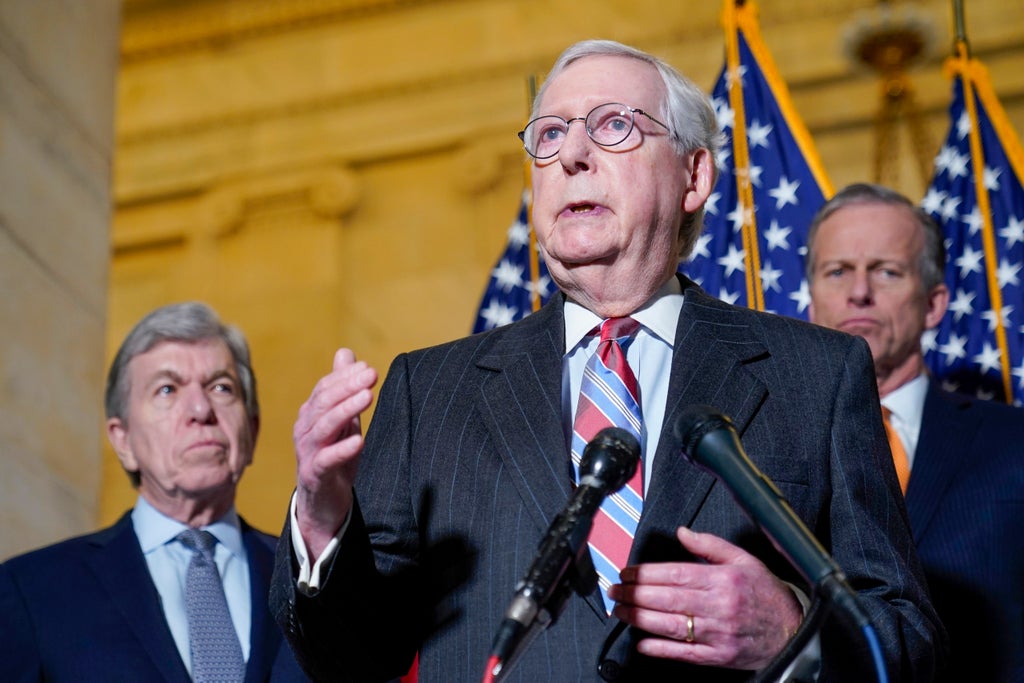
The Senate minority leader is the highest-ranking Republican to criticise the censure of Reps Liz Cheney and Adam Kinzinger (https://www.independent.co.uk/news/world/americas/us-politics/mcconnell-rnc-jan-6-capitol-b2010744.html)
The Senate minority leader is the highest-ranking Republican to criticise the censure of Reps Liz Cheney and Adam Kinzinger
The Senate minority leader is the highest-ranking Republican to criticise the censure of Reps Liz Cheney and Adam Kinzinger
McConnell, GOP senators criticize RNC for censuring Cheney, Kinzinger
“That’s not the job of the RNC,” the Senate minority leader said Tuesday. (https://www.cbsnews.com/news/mcconnell-rnc-senate-republicans-censure-liz-cheney-adam-kinzinger/)
“That’s not the job of the RNC,” the Senate minority leader said Tuesday.
“That’s not the job of the RNC,” the Senate minority leader said Tuesday.
| New York | Majority Leader |
| United States | Ranking Member |
| Majority Leaders | Mitch Mcconnell |
| Global Warming | Political Party |
| Reid Succeeded | Former House |
| Currently Serves | Philippines 2020 |
| 8th Assembly | Daschle’s Successor |
| Akpabio Resigns | Nancy Pelosi |